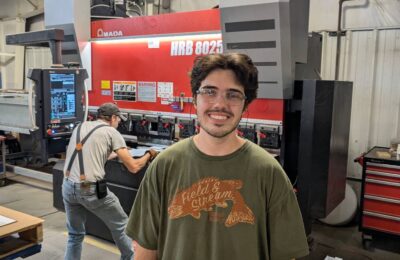




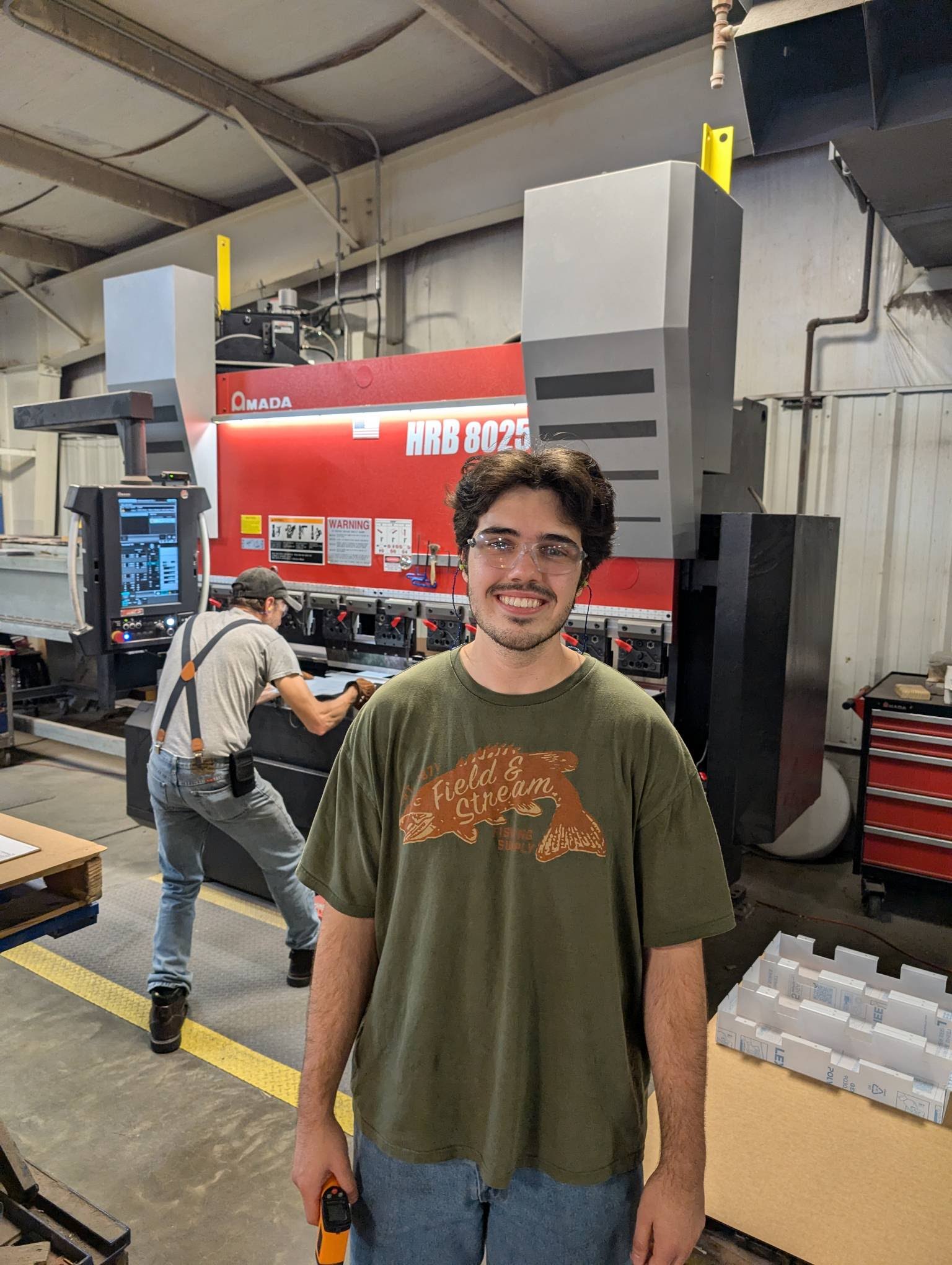
06 Aug From the Classroom to the Shop Floor: Anthony’s Summer at MetPlas
When Anthony joined MetPlas this summer, he was looking for a fast-paced work environment built around teamwork.
As a mechanical engineering student beginning his first professional job, he wanted to learn what engineering looked like beyond the classroom.
“I wanted to be somewhere that moves fast and depends on people working together,” Anthony said. “That’s what I got.”
Bringing Consistency to Lexan Bending
Anthony spent much of the summer working on a Lexan bending project. His goal was to determine the dwell time and oven temperature needed to produce parts consistently enough for production.
The objective was clear: reduce variation and establish a reliable process.
Finding the solution required more investigation than he initially expected.
“I assumed I’d find one or two variables and be done,” he said. “There were a lot more than I expected. You can’t guess at it—you have to go out on the floor, watch it happen, get the data, and actually dig into what the numbers are telling you.”
The project was not part of a school requirement. Anthony chose the opportunity because it gave him practical experience and allowed him to apply what he had learned in the classroom to a manufacturing environment—or, as he described it, “for the love of the game.”
Learning From the Shop Floor
Anthony credits several MetPlas employees with helping him understand the process and the larger manufacturing operation.
Jason, a press brake operator with more than 20 years of experience working with steel, became one of his primary teachers. Jason had never bent Lexan, and Anthony had never operated a press brake.
“Neither of us had the whole answer,” Anthony said. “He knew the machine and I knew how to figure out the material, and we filled in each other’s gaps until the problem made sense.”
Justin, Anthony’s supervisor, guided him through daily decisions and helped him understand how engineers approach problems in a manufacturing setting.
Dane, MetPlas’ manufacturing specialist, also included Anthony in additional projects outside of the Lexan work. Those assignments introduced him to other areas of the shop and broadened his understanding of the company’s operations.
Anthony said one of the biggest surprises was how collaborative the work became. Although part of his work took place in the office, the project depended on time spent on the shop floor and regular communication with production employees.
“I didn’t expect to be the person in the middle,” he said. “But most of the time, improving a process just meant getting the office and the floor into the same conversation.”
Developing New Skills
By August, Anthony was completing tasks he could not have handled when he arrived in May.
He strengthened his Excel and data-analysis skills while also learning how to observe a manufacturing process more carefully. He became better at identifying variables, recognizing patterns, collecting useful information and turning shop-floor observations into practical improvements.
What Comes Next
Anthony will return to school this fall to begin his junior year and plans to pursue a career in engineering.
He said his summer at MetPlas gave him a clearer understanding of what engineers do each day, including the way Justin manages responsibilities and works through production challenges.
“I came in knowing what an engineer does on paper,” Anthony said. “I’m leaving knowing what one actually does all day—and I’m more excited about it than when I got here.”
His advice to other students considering a manufacturing internship is straightforward.
“Take it. My first week I wasn’t confident at all, and by the end I was running my own project. There’s no version of this where you don’t come out ahead.”
MetPlas values opportunities to introduce students to manufacturing, engineering and the teamwork required to move projects from an idea to a repeatable production process.